

Daredevil Aircraft Controller Flies To Work Every Day – Just Not On An Airplane
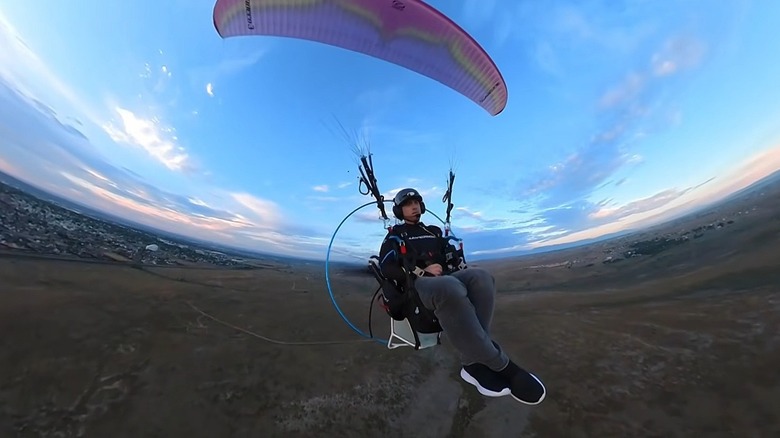
According to U.S. Census data, the average American commute to work in 2024 took just over 27 minutes. Of course, that's the mean figure, with those residing in U.S. cities with the worst traffic likely taking much longer. One Colorado man, Jacob Hutzler, has found a unique way to skip the ho-hum drive to work, at least for one day a week. He flies a paramotor instead.
Hutzler explains that years ago he was inspired by a video where a paramotor was used to transport a man to a fast-food chain and back home. While not explicitly referenced, this clip was possibly of YouTuber Tucker Gott and his nearly decade-old video, "Flying To McDonald's On My Paramotor." It went viral and is sitting at 50 million views, likely having inspired many others to take up paramotoring just like Hutzler.
However, there are probably very few individuals who can commute to their job in this way. Fortunately, Hutzler works at an airport as an air traffic controller, which certainly affords him some advantages, as his coworkers have a comprehensive understanding of flight paths. He even reportedly keeps them apprised of his progress, as a single person piloting a paramotor isn't visible on radar.
What is a paramotor exactly?
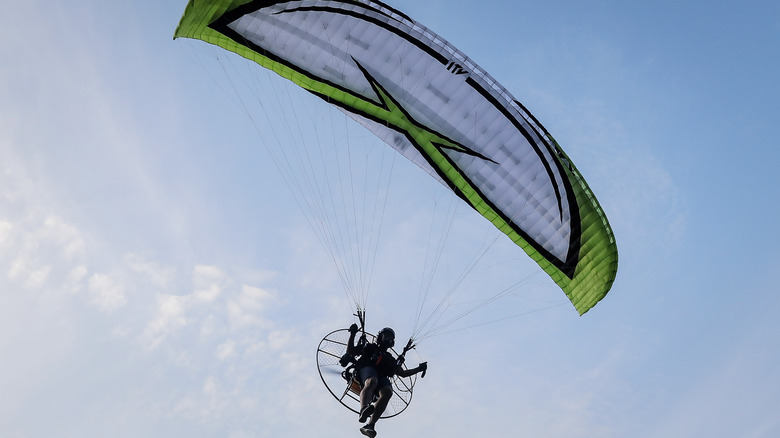
A paramotor is a form of ultralight aviation. Essentially, the pilot is suspended from a wing, which to the untrained eye looks similar to a parachute. However, instead of creating drag to bring you toward the ground, a paraglider wing helps generate lift. To get off the ground, gain elevation, and cruise at altitude, a small engine and propeller (encased in a protective cage) provide the thrust.
The record for paramotor altitude is 25,659 feet (7821 m), set by Spanish pilot Ramon Morillas Salmeron. However, all U.S. paramotor pilots have to stay below 18,000 feet unless granted an exception by the FAA. Depending on the type of wing, engine choice, and flying behavior, a paramotor can soar at speeds around 35 mph and ultimately can have a range beyond 200 miles, given the right conditions.
These are impressive figures, considering the U.S. doesn't require a pilot's license to fly a paramotor. It's also a much cheaper way to get into the air, as the equipment and training to get going are typically at or below $15,000. Contrast that dollar amount with the cost of a Cessna 152, which can cost tens of thousands more, though it is one of the best planes for getting your private pilot's license.
Why you may not want to commute by paramotor
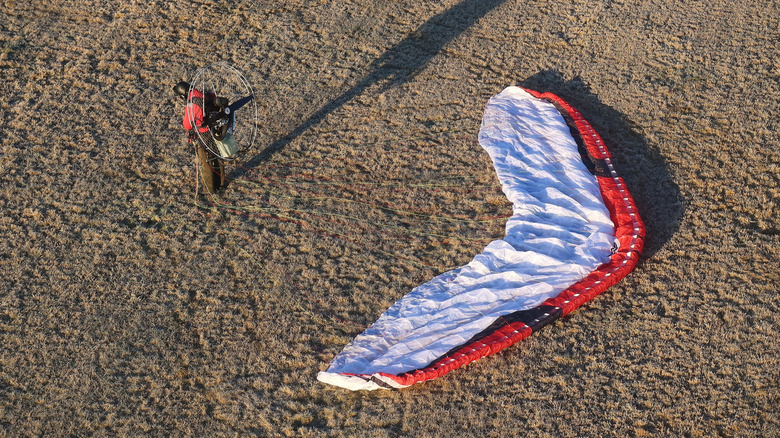
While flying to work one day a week does sound exciting, it turns out that in the case of Jacob Hutzler, going by car is actually quicker. This is because, when Hutzler flies, he's required to prepare for his flight, unfurl the large paramotor wing, and ensure the lines aren't tangled or bunched. And then of course, everything must be packed up once he reaches his destination. Obviously, hopping into your car, turning the ignition, and then parking outside a workplace requires far less effort.
There is also the matter of weather, which must be carefully evaluated prior to taking off. A minimal wind speed approaching 12 mph makes any paramotor pilot think twice about flying. Even certain times of day are more dangerous than others. Wind gusts and certain thermal conditions can cause a paramotor pilot to lose control or otherwise negatively affect the wing mid-flight. Training and experience are essential in preventing disaster, with veteran paramotor pilots learning to quickly land following a takeoff if the conditions don't feel right.