

There's A Reason Why The USS Abraham Lincoln Returned To Port Covered In Rust
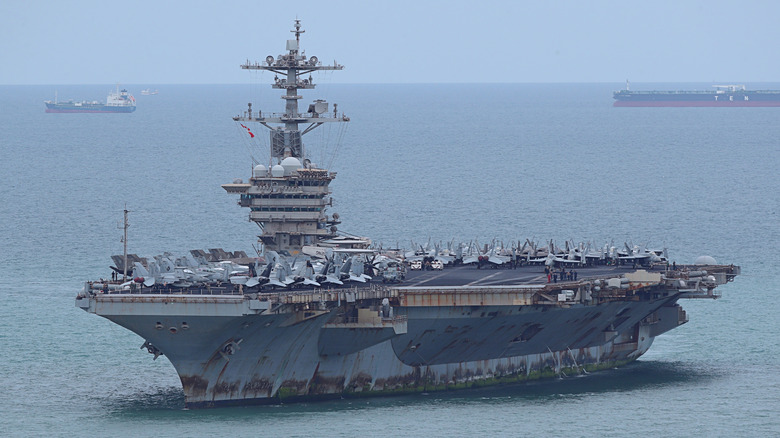
Throughout August 2026, news of the USS Abraham Lincoln (CVN-72) nuclear aircraft carrier filled the airwaves, and it wasn't positive coverage. An extended deployment that lasted 286 days without much time in port exhausted supplies and the sailors who served aboard the Lincoln. Things got so bad that one sailor jumped overboard. While that individual survived, it demonstrated precisely how bad things were on the Nimitz-class nuclear aircraft carrier.
When the Lincoln was ordered to return to its home port in early September 2026, the world got a glimpse of the carrier and what it looked like after so long on mission. To most observers, the mighty Lincoln looked awful, thanks to rust spots that ringed around the hull along the waterline. This made the carrier appear as though it had been at sea for decades, and while it's admittedly a bad look, the rust is actually to be expected, especially for such a long time at sea without a port call.
Retired U.S. Navy Capt. Carl Shuster told CNN, "Rust along the waterline is not unusual on a ship that has spent 60 days or more of operations continuously at sea." From his estimation, after looking at pictures and video of the Lincoln, preservation of the ship and removal of the rust could be accomplished in about 30 days. Fortunately, the Navy knows how to rectify the situation before sending the Lincoln out on another deployment.
Why the USS Abraham Lincoln is so rusty
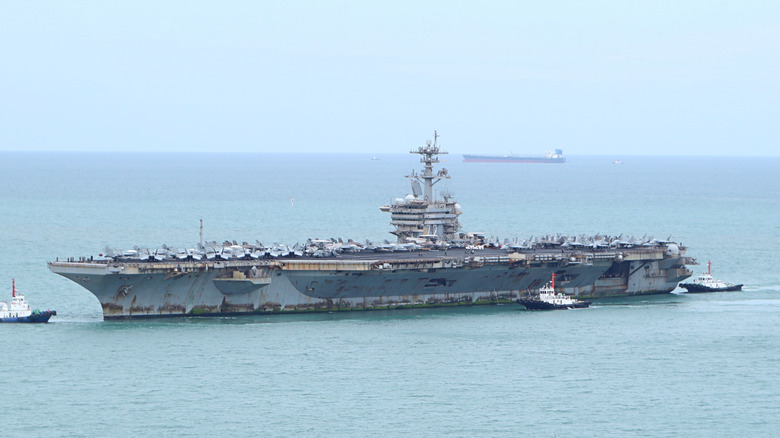
It's perfectly normal for a ship to rust in the manner the Lincoln did during its deployment. The main culprit is saltwater, which degrades and rusts the steel the carrier is made of, resulting in widespread rusting above the waterline.
When the Navy begins preserving the ship, the first parts they tackle will likely be the bow and other forward areas of the hull, as these take the most damage from choppy seawater as the ship moves forward. While sailors can begin preserving some areas of the ship while it's underway, that cannot happen along the waterline, which is the worst-looking part. That must be done once the ship returns to port and isn't subjected to wave action, allowing people to work on those areas to clean them of rust.
One thing about rust that some folks might not realize is that it spreads, and in doing so, it weakens steel. For this reason, the Navy deals with rust as quickly as possible to contain it before it worsens. In the case of the Lincoln, it was out at sea for so long that typical maintenance work couldn't be done along the waterline, so it was sent back to the USS Abraham Lincoln's home port, where such repairs and preservation work can be completed safely.