

What Does An All-Black Buoy Mean For Boating?
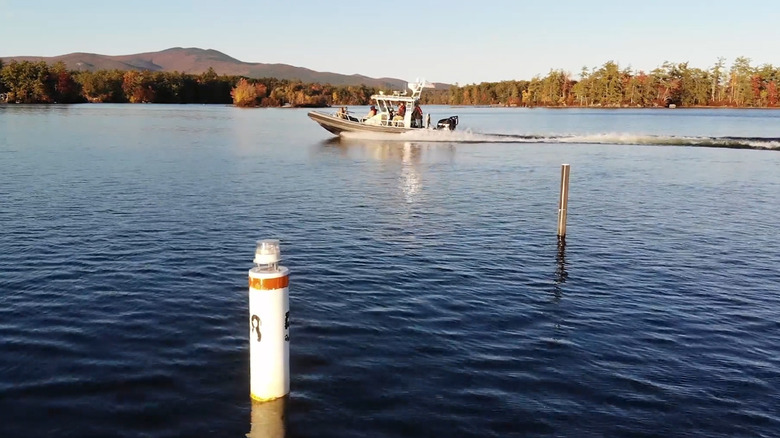
If you want to tell people where to go on a roadway, you stripe down some paint and stake down a sign or two. On a waterway, the U.S. Coast Guard (not the Navy) is the official authority along national and inland shores on buoys, the floating, moored markers that define where you should travel, where to avoid hazards, and where you can tie your vessel down. In the past, you'd see all-black buoys defining the leftmost limits of a navigable channel in the upstream direction while solid-red ones appeared in tandem on the right.
However, this changed with a merging of states-based and Coast Guard marking systems in 1998; since 2003, those leftside buoys are colored green instead of black and you'll find them along inland as well as coastal waters. In the latter case, where red and green buoys are placed will depend on which side the shore is.
Under federal law, private bodies and state authorities can request permission from the Coast Guard to use so-called Private Aids to Navigation on waterways under their respective jurisdiction. New Hampshire is a prominent example, where it exclusively employs thin spar buoys in its lakes and rivers to help boaters avoid the many submerged rockpiles you might expect to find in a place known as the Granite State. These buoys retain the black-and-red color scheme for channel markers that many states used prior to 1998.
How black is used in other navigational markers

The Coast Guard's current guide to Aids to Navigation — which adheres to standards set by the International Organization for Marine Aids to Navigation and Lighthouse Authorities (IALA) — features only one major marker with the color black on it. The Isolated Danger marker is primarily black, but with a red stripe near the top of it, and it also features two spherical black topmarks. It identifies an underwater obstruction that can be safely passed on all sides. Black may be used on range and locator dayboards, too, but those colors are chosen for visibility and are not otherwise significant. You're more likely to find black text on orange-striped buoys that signal some sort of immediate hazard.
While most jurisdictions with their own navigation aid code will share many elements with the Coast Guard's, sometimes the same design seen on both can mean very different things. In the case of a vertically-striped black-and-white buoy, Wisconsin's Department of Natural Resources will tell you to pass on either side as it only marks the center of a channel; the Coast Guard will tell you to avoid passing between it and the near shore because it marks an obstruction.